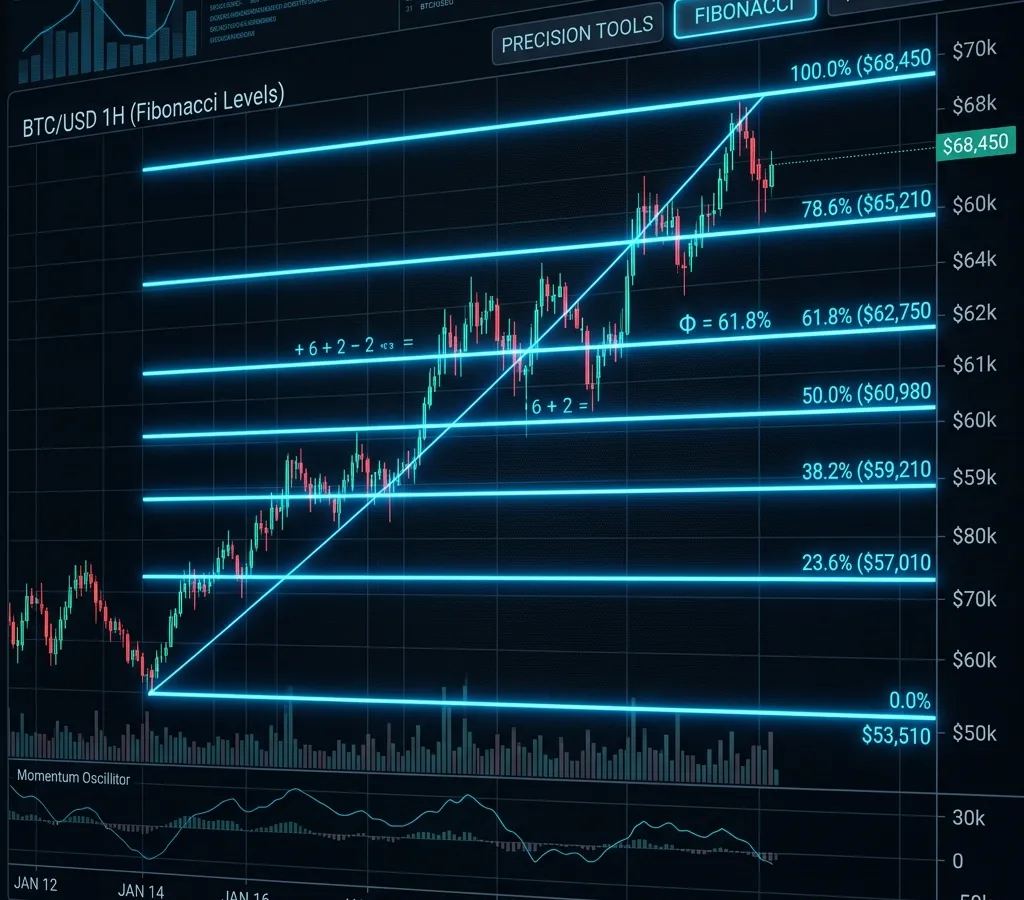
How Fibonacci Retracements Actually Work in Real Trading
A no-fluff guide to using Fibonacci retracements with structure, liquidity, and session timing instead of random line placement.
January 12, 2026 · 3 min read · by ChartzPayTheBillz
TL;DR: Fibonacci levels work best as reaction zones, not precise entry prices. Draw from meaningful swing points, combine with structure and liquidity, and execute only after confirmation. Treat 50%-79% as a decision area, not a guaranteed bounce zone.
What Is Fibonacci Retracement in Trading?
Fibonacci retracement is a percentage-based framework for estimating where pullbacks may react during a trend move.
Most traders lose with Fibonacci because they draw it from arbitrary points and take blind limit entries. The tool is valuable only when swings are objective and aligned with broader market context.
Why Fibonacci Still Has Value
- It creates a shared map many participants watch.
- It helps standardize pullback planning.
- It improves trade planning when combined with order-flow clues.
Fibonacci is weak when:
- The move is not impulsive.
- You are in middle-range chop.
- A major news release is about to distort behavior.
How to Use Fib Correctly
Pick Valid Swing Points
Use clear impulse leg extremes, not tiny internal candles. If two traders pick different anchors, the swing was probably not objective enough.
Work in Zones, Not Single Lines
The 0.5, 0.618, and 0.705-0.79 region often behaves like a zone. Reactions can overshoot before resolving.
Require Confirmation
Use rejection, displacement, or lower-timeframe structure shift before committing risk.
Practical Fib Setup Process
- Define trend direction from higher timeframe.
- Mark impulsive leg and draw retracement.
- Overlay liquidity, prior highs/lows, and session highs/lows.
- Wait for price behavior at zone.
- Execute with predefined invalidation and target logic.
Fib Level Comparison
| Level | Typical Interpretation | Best Use | Risk |
|---|---|---|---|
| 38.2% | Shallow pullback | Strong trend continuation | Often too shallow in volatile pairs |
| 50% | Mean reversion area | Mid-zone confluence entries | Not a true Fibonacci ratio but widely watched |
| 61.8% | Classic retracement | Continuation with confirmation | Blind entries can get run over |
| 70.5%-79% | Deep pullback / premium discount shift | Contrarian continuation and liquidity traps | High probability of invalidation if structure weak |
Common Mistakes
- Drawing Fib on every swing and over-trading.
- Entering at 61.8% without trigger.
- Ignoring news, spread expansion, and execution costs.
- Taking targets too close relative to stop distance.
FAQ
1. Is 61.8% the best Fib level?
No single level is always best. The best area is where Fib overlaps structure, liquidity, and session context.
2. Should I use Fib in ranging markets?
Only with caution. Fib performs better in directional conditions than in random range rotation.
3. Can I trade only Fib and nothing else?
You can, but performance is usually weak. Fib should be one layer inside a broader trading model.
4. Which timeframe is best for Fib?
Use higher timeframes for anchor swings, then refine entries on lower timeframes.
5. What invalidates a Fib setup?
Clean structural break beyond your invalidation zone and failure to reclaim decision levels after reaction.
Conclusion
Fibonacci is not a signal generator. It is a decision framework. Use it to frame pullbacks, then let price behavior and risk logic decide if the trade is worth taking.