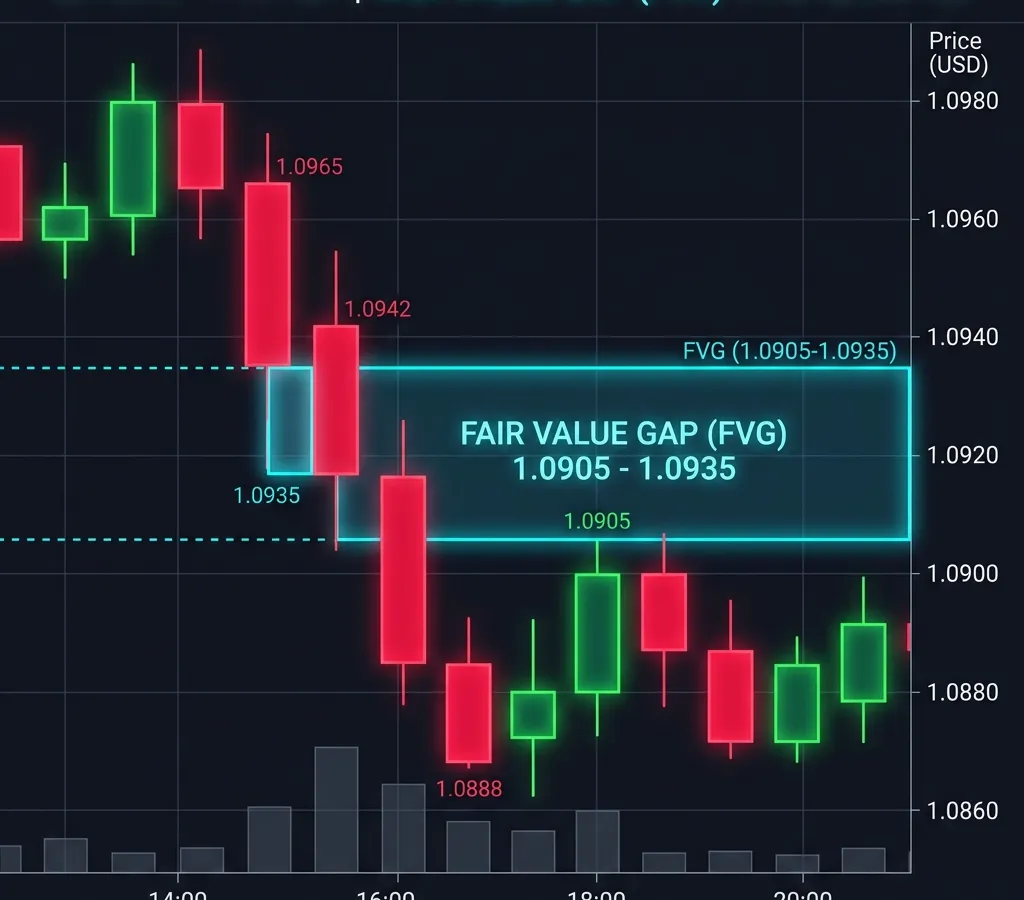
What Is an FVG? Fair Value Gaps Explained Without Hype
Learn what fair value gaps are, why they form, and how to trade them with structure, timing, and disciplined risk.
February 2, 2026 · 3 min read · by ChartzPayTheBillz
TL;DR: A fair value gap is an imbalance created when price moves so aggressively that part of the candle range is left untraded. FVGs are useful reaction zones, not guaranteed reversals. Trade them only with structure alignment and clear invalidation.
What Is a Fair Value Gap?
A fair value gap (FVG) is a three-candle imbalance where the wick/body overlap leaves a price area that was not efficiently traded.
In practice, an FVG marks aggressive one-sided order flow. Markets often revisit these zones to rebalance, but not every revisit becomes an entry.
Why FVGs Matter
- They highlight where momentum was strongest.
- They provide objective pullback zones.
- They pair well with continuation or reversal models depending on context.
FVGs are weak when used blindly in random chop or against higher-timeframe structure.
How FVGs Behave
Continuation FVG
Price returns into the gap and resumes trend after rejection.
Deep Fill FVG
Price fills most or all of the gap before finding direction.
Failed FVG
Price slices through and closes beyond invalidation, signaling weak original intent.
Practical FVG Trading Workflow
- Mark higher-timeframe directional bias.
- Identify impulsive move and valid FVG.
- Wait for return during active session.
- Watch lower-timeframe reaction inside zone.
- Execute with defined stop and target structure.
FVG Setup Comparison
| FVG Type | Best Context | Trigger | Warning Sign |
|---|---|---|---|
| Bullish continuation FVG | Uptrend with recent BOS | Rejection + bullish displacement | Close below gap and no reclaim |
| Bearish continuation FVG | Downtrend with recent BOS | Rejection + bearish displacement | Close above gap and no reclaim |
| Countertrend FVG | Liquidity sweep at higher-timeframe level | Strong rejection + structure shift | Weak momentum and repeated failures |
Common Mistakes
- Marking micro-gaps with no meaningful impulse.
- Entering at first touch without confirmation.
- Ignoring session timing and liquidity quality.
- Placing stops too tight inside noisy lower timeframe structure.
FAQ
1. Does every FVG get filled?
No. Some are partially filled, some fully filled, and some are ignored.
2. Is an FVG bullish or bearish by itself?
No. Bias comes from surrounding structure and liquidity context.
3. Which timeframe is best for FVGs?
Use higher timeframes for zone quality and lower timeframes for entry precision.
4. Should I set limit orders at every FVG?
No. Use confirmation to reduce low-quality entries.
5. What invalidates an FVG trade quickly?
Strong close beyond your invalidation and failure to reclaim zone direction.
Conclusion
FVGs are powerful when you treat them as context zones, not automatic signals. Build the trade from structure first, then let FVG help refine location and risk.