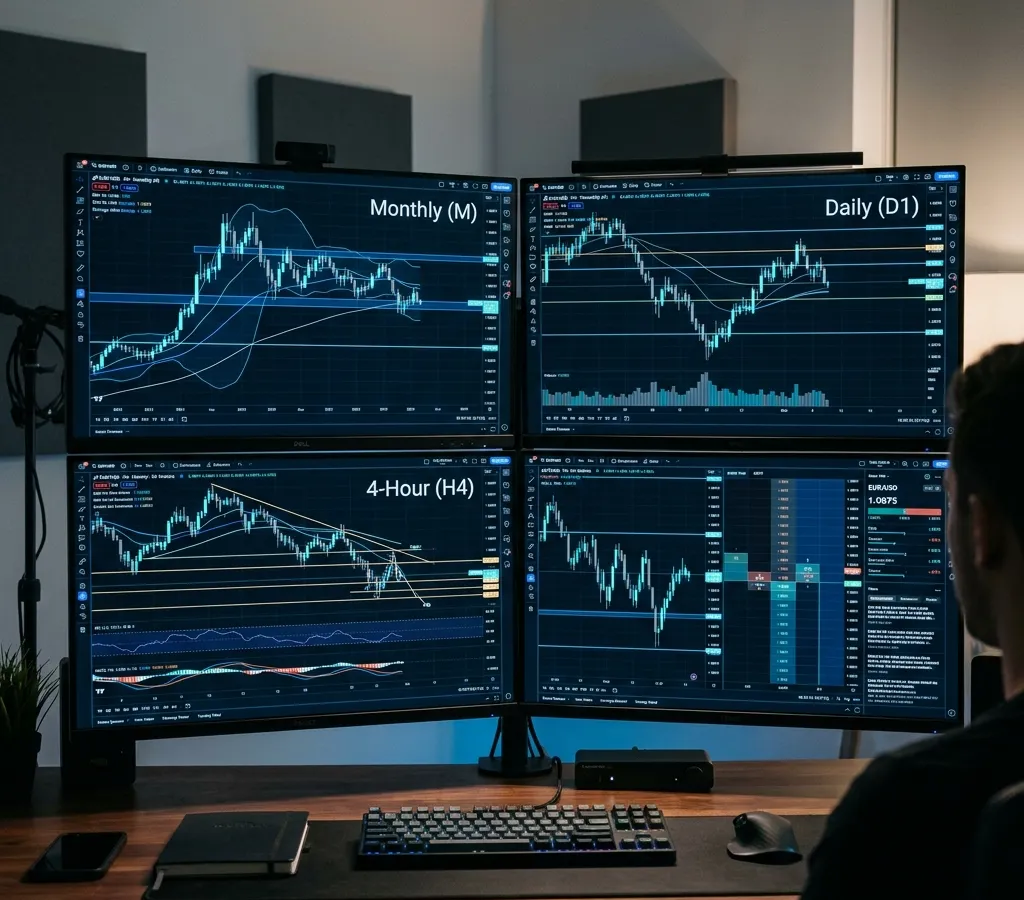
Top-Down Analysis: How to Align Timeframes Before You Enter
Learn a practical multi-timeframe workflow to align bias, refine entries, and avoid lower-timeframe noise.
March 9, 2026 · 3 min read · by ChartzPayTheBillz
TL;DR: Top-down analysis means starting from higher-timeframe structure and drilling down to execution timeframe only after bias is clear. It reduces random entries, improves invalidation logic, and keeps trades aligned with dominant flow.
What Is Top-Down Analysis?
Top-down analysis is a multi-timeframe decision process where higher-timeframe context defines directional bias and lower-timeframe action defines execution.
If you start on low timeframes, you usually inherit noise first and context later. That reverses priority and hurts decision quality.
Why Multi-Timeframe Alignment Matters
- Higher timeframe controls directional environment.
- Lower timeframe improves precision.
- Alignment improves expectancy by filtering low-quality setups.
Misalignment often leads to entries that are technically valid but contextually weak.
How to Run Top-Down Analysis
Step 1: Higher Timeframe Bias
Mark weekly/daily structure, key highs/lows, and major liquidity.
Step 2: Intermediate Timeframe Setup
Locate potential reaction zones and scenario paths.
Step 3: Execution Timeframe Trigger
Wait for confirmation in your zone: rejection, displacement, or structure shift.
Practical Session Workflow
- Weekly map on weekend.
- Daily update before London session.
- Execution plan with clear invalidation.
- Trade only if lower timeframe confirms higher-timeframe thesis.
- Review whether alignment was present or forced.
Timeframe Role Comparison
| Timeframe Layer | Main Job | Typical Mistake | Best Practice |
|---|---|---|---|
| Higher timeframe | Direction and regime | Ignored during scalping | Always define bias first |
| Mid timeframe | Zone and scenario design | Overcomplicating levels | Keep only key decision zones |
| Lower timeframe | Trigger and execution | Entering before confirmation | Use strict trigger checklist |
Common Mistakes
- Taking lower-timeframe signals against major higher-timeframe levels.
- Changing higher-timeframe bias mid-session due to one candle.
- Entering outside planned zone from impatience.
- Using too many timeframes and creating confusion.
FAQ
1. How many timeframes should I use?
Three layers are usually enough: context, setup, and execution.
2. Can I trade only one timeframe?
Yes, but you lose context and often take lower-quality entries.
3. What if lower timeframe conflicts with higher timeframe?
Stand down or reduce size until alignment returns.
4. Is top-down analysis slower?
It is slower initially, but it saves time by reducing bad trades.
5. Which market benefits most from top-down analysis?
All liquid markets benefit, especially FX pairs and gold.
Conclusion
Top-down analysis is a decision hierarchy. Let higher timeframes tell you where to focus, then let lower timeframes tell you when to act.